Multi-cluster Kubernetes management, without assembling the landscape.
Portainer is a centralized multi-cluster management platform that does the job of the dozen CNCF projects you would otherwise choose, install, upgrade, and staff. Sixty tools, twelve platform decisions, twelve lifecycles to own: that is what assembling it yourself actually costs. This is the alternative for the engineers actually looking for one.
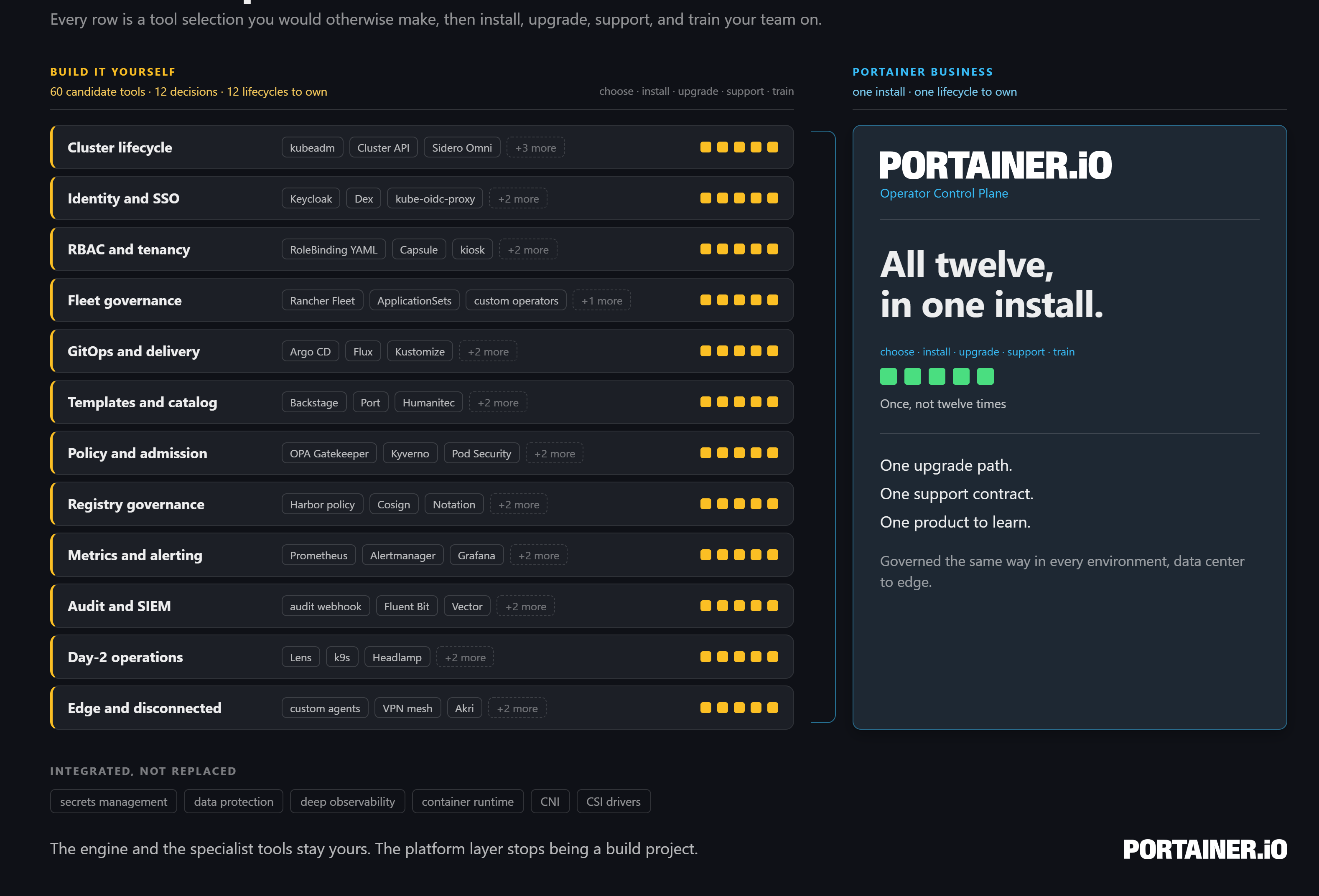 Click to view the full comparison
We are not trying to win the landscape. We are the alternative to it.
You can assemble sixty open-source projects into a platform. Teams do it every day. They spend eighteen months on it, hire to keep it alive, and file the maintenance under "platform engineering." We think that was a decision most teams were talked into, not one they would make twice.
Portainer is for the ones who already worked that out. If you want to build and run the platform layer yourself, we are genuinely not for you, and we are at peace with that. If you would rather it were already built, correctly, and governed the same way from one cluster to three thousand edge nodes: that is the entire point of this product.







One platform, the whole lifecycle
The capabilities you would otherwise assemble from a dozen projects, delivered as one product with one owner.
Multi-cluster fleet management
Centralized governance across every Kubernetes cluster, on any distribution: EKS, AKS, GKE, bare metal, or on-premises. Existing Docker and Swarm hosts join the same console.
GitOps deployment workflows
A centralized GitOps engine on the Portainer server, not a controller running inside every cluster. Promotion from dev to staging to production with rollback, without distributed Argo or Flux installs.
Self-service with guardrails
Let developers deploy without becoming the bottleneck. Pre-defined templates, resource quotas, and RBAC enforcement keep control where it belongs.
Enterprise identity and access
Centralized SSO, LDAP, and OIDC. Role-based access built for real operational teams, with full audit logging and SIEM export.
Docker, Swarm, and Podman, from the same console.
Portainer did not start as a Kubernetes tool, and it did not leave the rest behind. Docker, Docker Swarm, and Podman are first-class in the same console, under the same RBAC, as your Kubernetes clusters. You do not have to migrate a working Swarm estate to be governed properly, and you do not stand up a second tool to manage it. One console, every runtime you actually run.
Bespoke vs standard
Both approaches run your containers. Only one of them has an owner, an end date, and someone you can hire to run it.
The stack is free like a puppy is free.
Deliberately less, on purpose, so what remains is supportable.
Ready to bring back operational control?
Deploy in minutes and see the difference for yourself. Get 3 nodes free, or talk to a team that speaks enterprise infrastructure without the generic sales process.